G
7.0
Gameplay 30%
Gameplay was not playtested. Default score 7.0. This dimension was not playtested, and the default is what the ranking uses.


Home / Reviews / region-animal-deduction / Zoodoku!
Zoodoku is an especially clear concept fit for players who enjoy constraint propagation without arithmetic. It is less suited to someone looking for a conventional Sudoku board or a casual hidden-cat hunt. The overlapping placement rules are substantive; the quality and uniqueness of the actual puzzle collection still need independent checking.
Opens the official store and leaves this site. Kids: ask a grown-up before buying anything.
Zoodoku dresses a constraint puzzle in animal themes, but its most interesting quality is the rule set. You are not simply finding a cat in a picture: you are deciding where animals can legally go while several restrictions overlap. This source-based analysis uses the US App Store listing, not hands-on play.
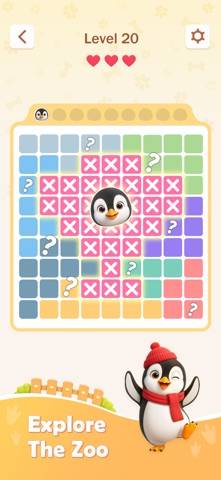
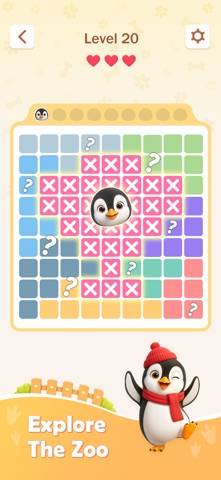
The listing says to place exactly one animal in each colored region. Animals cannot share a row or column, and they cannot touch diagonally. A legal position therefore has consequences beyond its own region.
For example, choosing a square can rule out other positions along the same row and column while also affecting nearby diagonal squares. This is a general explanation of the listed constraints, not a solution to a particular unseen board. The challenge is to use those exclusions together until the arrangement works.
The developer compares the game with Sudoku and Minesweeper, but the stated rules do not make it either one. There are no supplied digit-completion rules or mine counts. The more accurate category is region-based placement deduction with spacing restrictions.
The description claims every puzzle has one solution and requires no guessing. That is an attractive proposition for players who want each decision to follow from evidence. It has not been established by a solver audit or hands-on examination of the level set.
The listing advertises hundreds of handcrafted boards, daily puzzles, and additional animal themes beyond the starting cats. Those themes are described as preserving the same core rules. They may provide a collecting incentive without fundamentally changing the deduction task.
There are no saved customer-review bodies to show whether the later puzzles maintain a clear logical path or whether the interface helps track exclusions. Notes, undo behavior, error checking, and accessibility features are not fully documented in the supplied text.
The developer advertises offline play. That remains an untested capability, not a verified statement about every daily or optional feature. The metadata records a free download, but the supplied description does not establish ads, paid hints, or a removal offer.
Animal themes are described as preserving the rules, so changing the theme should not be mistaken for an entirely different kind of puzzle.
Zoodoku is an especially clear concept fit for players who enjoy constraint propagation without arithmetic. It is less suited to someone looking for a conventional Sudoku board or a casual hidden-cat hunt. The overlapping placement rules are substantive; the quality and uniqueness of the actual puzzle collection still need independent checking.
View the official US App Store listing · How evidence differs from playtesting
No gameplay, ad, purchase, offline, or stability testing performed.
Gameplay was not playtested. Default score 7.0. This dimension was not playtested, and the default is what the ranking uses.
Ads were not playtested, and this game has no separate store-ad sample. The no-forced-ads tag stays unknown. Default score 7.0. This dimension was not playtested, and the default is what the ranking uses.
Whether a purchase is required to keep playing was not playtested. Default score 7.0. This dimension was not playtested, and the default is what the ranking uses.
Content depth was not playtested. Default score 7.0. This dimension was not playtested, and the default is what the ranking uses.
Stability was not playtested. Default score 7.0. This dimension was not playtested, and the default is what the ranking uses.
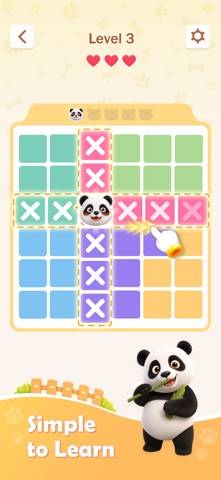
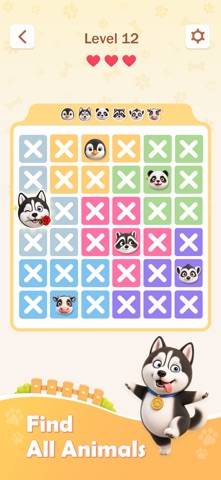
No. The listed rules concern animals, colored regions, rows, columns, and diagonal spacing rather than digits.
Exactly one, according to the description.
No. Diagonal contact is explicitly prohibited.
No. The developer makes that claim, but the level set was not audited here.