G
7.0
Gameplay 30%
Gameplay was not playtested. Default score 7.0. This dimension was not playtested, and the default is what the ranking uses.


Home / Reviews / word-deduction / Word Guess - Word Games

Word Guess communicates its core feedback rules clearly. It is a concept fit for constrained word deduction, while dictionary details, repeated letters, and access conditions remain important unanswered questions.
Opens the official store and leaves this site. Kids: ask a grown-up before buying anything.
Store-listing analysis, not a playtest. This article examines the US App Store description and attributed product claims. Customer review sample: N=0; no review date or version window is available.
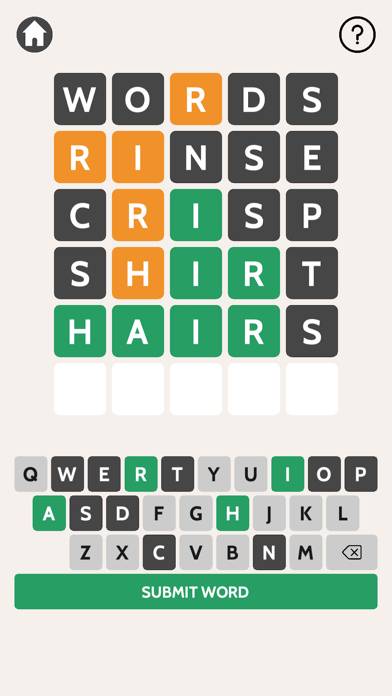
Word Guess - Word Games gives you six attempts to identify a mystery word. Each submitted guess becomes information for the next one through a three-color feedback system.
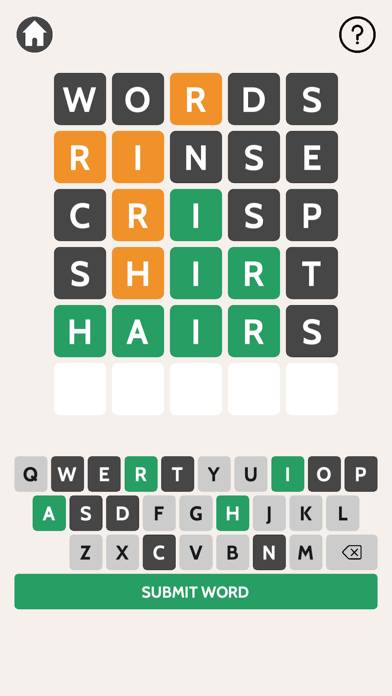
Gray means the letter is absent. Orange means the letter belongs in the answer but not in that position. Green marks a correct letter in the correct place. That turns an unsuccessful guess into a set of restrictions rather than simply a lost turn.
A useful next guess must account for what is already known while exploring what remains uncertain. That is the central deduction appeal, not a promise that one opening word will always solve the puzzle.
The official image shows five-letter guesses, a matching on-screen keyboard, and colored feedback across several rows. It demonstrates a five-letter example, but the brief written description does not establish that every available mode always uses that length.
A limit of six attempts distinguishes this from an unrestricted anagram search. Each submission uses part of that budget, so there is a trade-off between testing possibilities and committing to a likely answer.
The description does not explain duplicate-letter handling, acceptable guess dictionaries, or whether invalid words consume a turn. Those details matter considerably in a feedback puzzle and should not be imported automatically from another familiar word game.
Nor does the listing establish a daily-only schedule, unlimited puzzle access, answer sharing, or a hard mode. A recognizable format is not proof of every feature associated with it elsewhere.
Consider Word Guess if you enjoy eliminating letters and positions through evidence. It is less suitable if you mainly want crossword clues, visible scrambled letters, or a story reward after each board.
The color system is also a practical selection issue. The official image uses color prominently, but the supplied description does not identify an alternative symbol mode or color-vision settings. Their absence from this evidence is not proof that none exist; it is a reason to check if they matter to you.
The US download is free. Advertising, purchases, offline support, statistics, and retry conditions are not established. There are no customer review bodies in this sample to support claims about word-list quality or unobtrusive play.
Choose on the clearly documented six-guess deduction loop, not assumptions about a complete feature match with another app.
Word Guess communicates its core feedback rules clearly. It is a concept fit for constrained word deduction, while dictionary details, repeated letters, and access conditions remain important unanswered questions.
The listing specifies six attempts to identify the mystery word.
The letter is in the answer but in the wrong position.
The supplied description does not document duplicate-letter feedback rules.
No hands-on gameplay, advertising, purchase, offline, or stability testing.
Gameplay was not playtested. Default score 7.0. This dimension was not playtested, and the default is what the ranking uses.
Ads were not playtested, and this game has no separate store-ad sample. The no-forced-ads tag stays unknown. Default score 7.0. This dimension was not playtested, and the default is what the ranking uses.
Whether a purchase is required to keep playing was not playtested. Default score 7.0. This dimension was not playtested, and the default is what the ranking uses.
Content depth was not playtested. Default score 7.0. This dimension was not playtested, and the default is what the ranking uses.
Stability was not playtested. Default score 7.0. This dimension was not playtested, and the default is what the ranking uses.
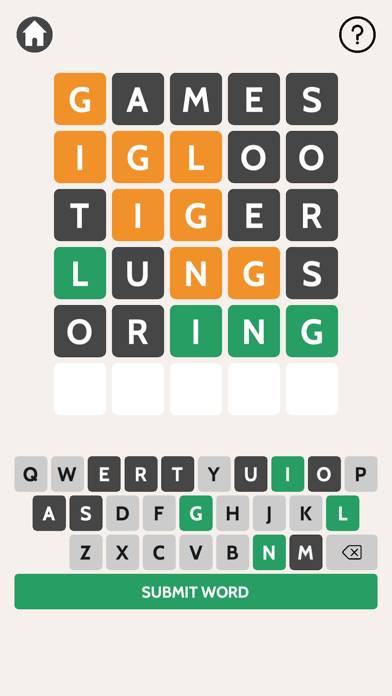
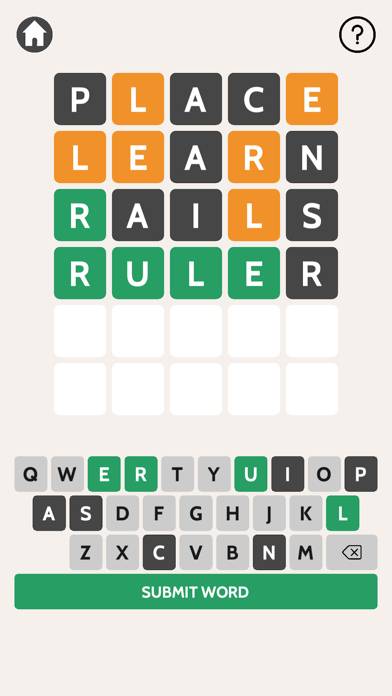
The listing specifies six attempts to identify the mystery word.
The letter is in the answer but in the wrong position.
The supplied description does not document duplicate-letter feedback rules.