G
7.0
Gameplay 30%
Gameplay was not playtested. Default score 7.0. This dimension was not playtested, and the default is what the ranking uses.


Home / Reviews / word-collapse / Word Crush® - Fun Puzzle Game
Word Crush’s shifting letters provide a concrete word-puzzle hook. Its expanding side modes and interruption reports make it a more conditional choice for readers who want a simple, quiet word routine.
Opens the official store and leaves this site. Kids: ask a grown-up before buying anything.
Player-review analysis, not a playtest. Sources: the US App Store listing and 50 US reviews dated 2026-03-12–2026-11-06 (Asia/Shanghai), covering versions 4.0.5, 4.0.6, 4.0.7, 4.0.8, 4.0.9, 4.1.0, 4.1.2, 4.1.9, 4.2.0, 4.2.1, 4.2.2, 4.2.4, 4.2.5, 4.2.6, 4.2.7. This limited, self-selected sample is not representative; player reports are not independently verified.
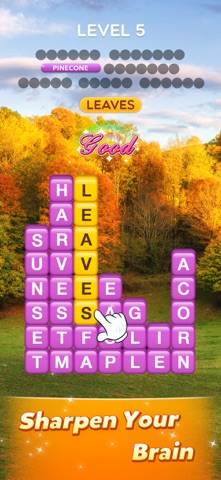
Word Crush® - Fun Puzzle Game makes a found word change the board. Correct answers remove letter blocks and let others cascade, so the next search happens in a different arrangement.
The listing describes searching, swiping, and connecting letters, with more than 18,000 levels advertised. Nature backgrounds frame the main activity. The falling-block consequence is the useful mechanical distinction: identifying an answer also reshapes what remains.
The app additionally advertises tile matching, sorting, screw puzzles, and other side activities. Those are not implied by the crossword label, and they matter when choosing an app for a focused word routine. Some readers want variety in the same place; others want fewer competing tasks.
One reviewer likes how the words flow together. Another enjoys both the word section and matching game, but objects when the latter becomes very small. That is a specific readability complaint about a side mode, not proof that the entire interface is unreadable.
The sample also contains disagreement with word acceptance and slang choices. Such criticism is relevant to dictionary expectations, but does not establish that every contested answer is invalid English. A preference for familiar vocabulary is different from a verified lexicon audit.
Several accounts describe opening failures or crashes around updates. Crucially, one reviewer says an update restored access and all their data; another explicitly updates an earlier complaint to say the app functions again. These later statements should not disappear from a summary simply because the original failure reports are more dramatic.
Other reviewers still report obstructing black boxes or login difficulties. The sample spans March to November 2026 and many releases, so it cannot establish a single current stability state.
Mid-game advertising is a prominent complaint. One purchaser says paid removal was satisfactory, while another objects to purchase pop-ups despite paying to remove ads. Those experiences are not necessarily describing the same kind of interruption: an external ad and an in-game sales offer are different systems.
The US download is free, and offline play is advertised. Current offer coverage and prices remain unverified. Consider Word Crush if cascading word discovery and optional variety both appeal, while checking how much interface and promotion activity you want around them.
Word Crush’s shifting letters provide a concrete word-puzzle hook. Its expanding side modes and interruption reports make it a more conditional choice for readers who want a simple, quiet word routine.
The listing says correct answers cause letter blocks to cascade down, changing the board.
No. Tile matching, sorting, and screw-based side games are also advertised.
Some reviewers explicitly report later recovery, while others describe continuing problems. The sample does not establish a universal current outcome.
No hands-on gameplay, advertising, purchase, offline, or stability testing.
Gameplay was not playtested. Default score 7.0. This dimension was not playtested, and the default is what the ranking uses.
Ads were not playtested, and this game has no separate store-ad sample. The no-forced-ads tag stays unknown. Default score 7.0. This dimension was not playtested, and the default is what the ranking uses.
Whether a purchase is required to keep playing was not playtested. Default score 7.0. This dimension was not playtested, and the default is what the ranking uses.
Content depth was not playtested. Default score 7.0. This dimension was not playtested, and the default is what the ranking uses.
Stability was not playtested. Default score 7.0. This dimension was not playtested, and the default is what the ranking uses.
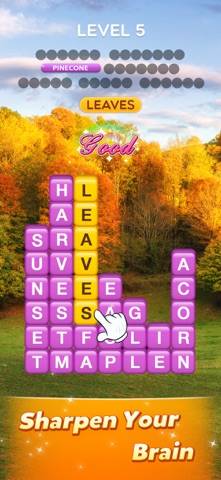
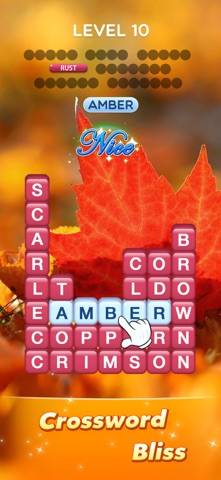
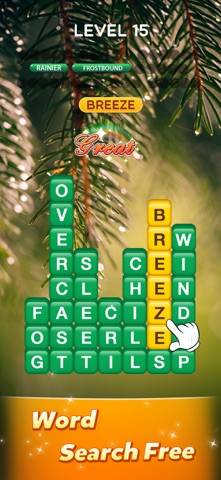
The listing says correct answers cause letter blocks to cascade down, changing the board.
No. Tile matching, sorting, and screw-based side games are also advertised.
Some reviewers explicitly report later recovery, while others describe continuing problems. The sample does not establish a universal current outcome.