G
7.0
Gameplay 30%
Gameplay was not playtested. Default score 7.0. This dimension was not playtested, and the default is what the ranking uses.


Home / Reviews / triple-tile-match / Triple Tile: Match Puzzle Game
Triple Tile is a clear concept match for three-tile visual matching with map progression. Its relaxed pitch leaves tray capacity and mistake rules open, so those should be checked before assuming a familiar or forgiving system.
Opens the official store and leaves this site. Kids: ask a grown-up before buying anything.
Store-listing analysis, not a playtest. This article examines the US App Store description and attributed product claims. Customer review sample: N=0; no review date or version window is available.
Triple Tile: Match Puzzle Game focuses on sets of three identical tiles. The board clears through recognition and selection, while layered layouts introduce a reason to think beyond the most obvious matching pictures.
The description tells you to tap and combine three identical tiles. Although it uses match-3 language, it does not describe swapping adjacent pieces to make a line. The more precise expectation is selecting matching tiles from a layout.
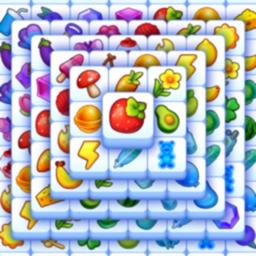
Layered challenges and varying arrangements are explicitly advertised. A covered design can create a sequence question: clearing an available set may expose different options underneath. That is the likely planning attraction of layers, without assuming a complete rule set that the listing does not provide.
In particular, the text does not establish the capacity of a holding tray, the exact selection restrictions, or whether matches clear automatically. Those are important details in tile-triple games. A familiar genre convention should not become a made-up specification for this app.
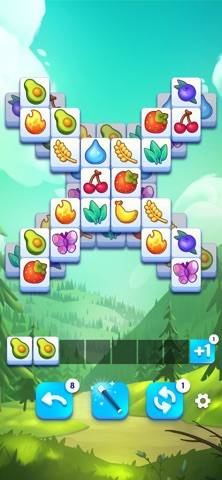
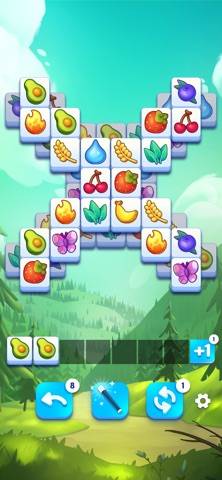
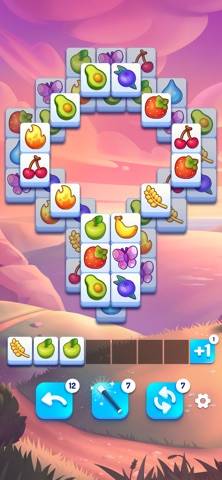
The official image shows layered fruit and flower tiles above a holding tray and assistance buttons. It confirms that selection has a separate staging area without establishing its universal capacity or tool costs.
The listing describes a map with destinations such as beaches and forests. Chapters change the backdrop while tracking progress through the puzzle collection. That offers a visible journey, not evidence of an explorable world or story choices.
Thousands of levels and regular additions are advertised. The count and update cadence have not been independently audited, and a large catalog does not prove that every layout introduces a new mechanic. The supplied text does not explain later obstacles or assistance tools.
Consider Triple Tile if repeated visual matching and gradually opening layered boards are appealing. It is less suitable if the requirement is arithmetic deduction, authored word clues, or the pair-removal rules of traditional mahjong solitaire.
The developer explicitly advertises play without an internet connection. That remains a listing claim rather than a test of downloads, account access, or every event. The US download is free.
Ad frequency, purchase options, ad removal, timers, undo availability, and the cost of mistakes are not established. There are no customer review bodies in this sample to support claims about fair difficulty or unobtrusive monetization.
The relaxed presentation and brain-training language should not be treated as proof of clinical benefits or pressure-free play. The decision-useful premise is a three-of-a-kind clearing task spread across layered layouts and a destination map.
Triple Tile is a clear concept match for three-tile visual matching with map progression. Its relaxed pitch leaves tray capacity and mistake rules open, so those should be checked before assuming a familiar or forgiving system.
The listing specifies three identical tiles, rather than mahjong-solitaire pairs.
The described action is tapping and combining tiles. Adjacent-swap rules are not established.
The supplied description does not specify tray capacity or complete tray rules.
No hands-on gameplay, advertising, purchase, offline, or stability testing.
Gameplay was not playtested. Default score 7.0. This dimension was not playtested, and the default is what the ranking uses.
Ads were not playtested, and this game has no separate store-ad sample. The no-forced-ads tag stays unknown. Default score 7.0. This dimension was not playtested, and the default is what the ranking uses.
Whether a purchase is required to keep playing was not playtested. Default score 7.0. This dimension was not playtested, and the default is what the ranking uses.
Content depth was not playtested. Default score 7.0. This dimension was not playtested, and the default is what the ranking uses.
Stability was not playtested. Default score 7.0. This dimension was not playtested, and the default is what the ranking uses.
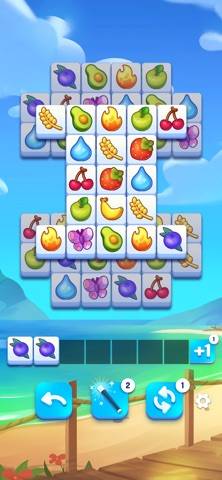
The listing specifies three identical tiles, rather than mahjong-solitaire pairs.
The described action is tapping and combining tiles. Adjacent-swap rules are not established.
The supplied description does not specify tray capacity or complete tray rules.