G
7.0
Gameplay 30%
Gameplay was not playtested. Default score 7.0. This dimension was not playtested, and the default is what the ranking uses.


Home / Reviews / rotatable-3d-directional-tap-away / Tap Master™ - Take Blocks Away
Tap Master is a plausible fit for readers who enjoy inspecting a three-dimensional arrangement and progressively removing obstructions. It is less conclusive for someone who specifically needs an untimed, mistake-free experience. Its directional exits and rotating viewpoint provide a clear identity without turning it into a Rubik's Cube game.
Opens the official store and leaves this site. Kids: ask a grown-up before buying anything.
Tap Master uses a three-dimensional structure as something to dismantle. Its references to Rubik's puzzles should not obscure the actual stated task: identify a block that can leave and tap it away. This source-based analysis uses the US App Store listing, not hands-on play.
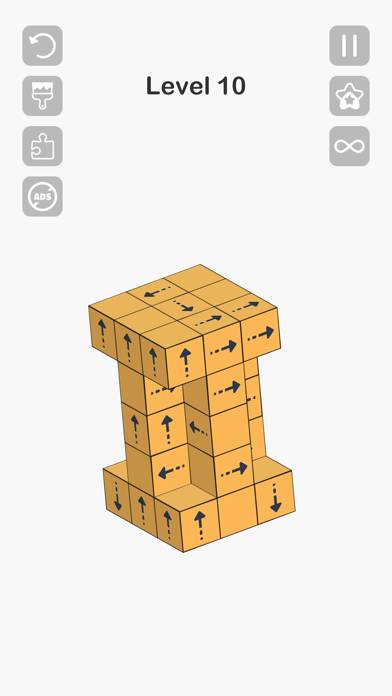
The developer describes tapping boxes whose arrows point outward. Correct choices free a block, while rotating the cube reveals other sides and potentially another available exit.
That gives rotation a particular role. It changes what the player can inspect; it is not described as turning colored layers to restore matching faces. A reader seeking a conventional twisty-cube simulator should not be promised one.
The interesting decision is finding a viable direction within a structure whose remaining pieces can obstruct one another. Looking at another side can reveal an option that was not obvious from the current angle.
The listing advertises different sizes, forms, and colors, with difficulty increasing as the player advances. A larger or less regular arrangement can require checking more relationships before a useful move becomes apparent.
That is an implication of the advertised design, not an independently measured difficulty curve. The description does not fully explain what happens after an incorrect tap, whether there is a mistake allowance, or whether any stage has a countdown.
The mix of tap and swipe language also does not provide a complete gesture reference. The clearest written distinction is tapping to remove and rotating to inspect.
Three-dimensional graphics, sound, and effects are promoted, along with suitability for shared family play. No screenshot or audio session was inspected, so their actual clarity, intensity, and comfort are not independently evaluated.
The brain and IQ language should remain promotional. Finding a directional exit can be an engaging spatial activity without providing a validated intelligence assessment.
No customer-review bodies are available in the supplied evidence. There is no supported player consensus about later-stage complexity, repeated shapes, control sensitivity, or accessibility.
The metadata records a free download. The description does not establish advertising frequency, paid removal, helper prices, offline support, or current stability. None should be inferred from the simplicity of the premise.
Tap Master is a plausible fit for readers who enjoy inspecting a three-dimensional arrangement and progressively removing obstructions. It is less conclusive for someone who specifically needs an untimed, mistake-free experience. Its directional exits and rotating viewpoint provide a clear identity without turning it into a Rubik's Cube game.
View the official US App Store listing · How evidence differs from playtesting
No gameplay, ad, purchase, offline, or stability testing performed.
Gameplay was not playtested. Default score 7.0. This dimension was not playtested, and the default is what the ranking uses.
Ads were not playtested, and this game has no separate store-ad sample. The no-forced-ads tag stays unknown. Default score 7.0. This dimension was not playtested, and the default is what the ranking uses.
Whether a purchase is required to keep playing was not playtested. Default score 7.0. This dimension was not playtested, and the default is what the ranking uses.
Content depth was not playtested. Default score 7.0. This dimension was not playtested, and the default is what the ranking uses.
Stability was not playtested. Default score 7.0. This dimension was not playtested, and the default is what the ranking uses.
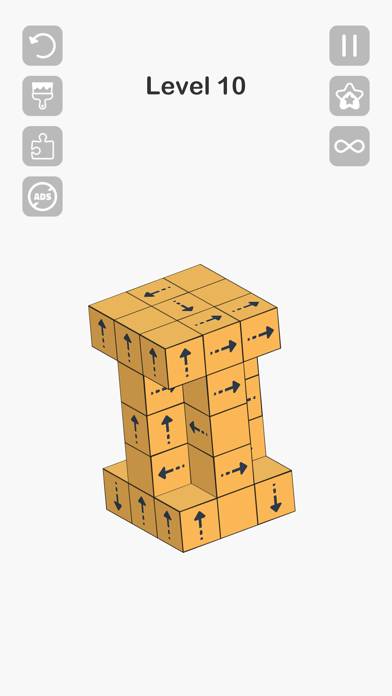
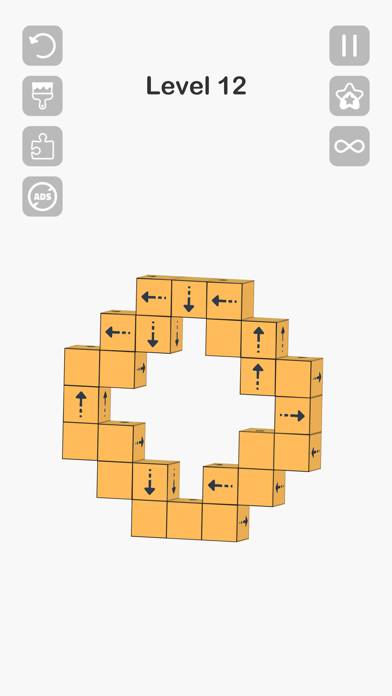
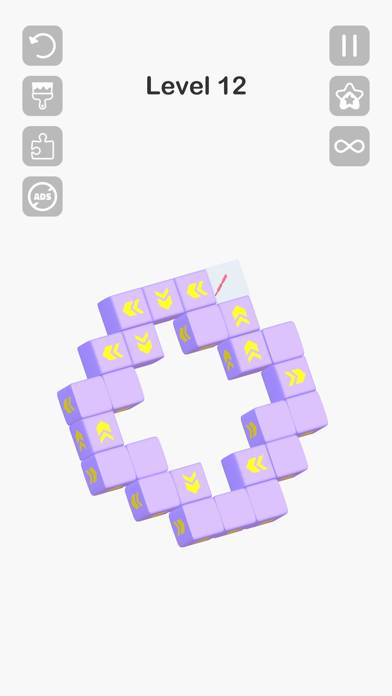
To inspect other sides and find an unlockable block.
The documented objective is block removal, not restoring colored faces.
No. The supplied description does not fully explain them.
No. It is not documented here or independently tested.