G
7.0
Gameplay 30%
Gameplay was not playtested. Default score 7.0. This dimension was not playtested, and the default is what the ranking uses.



Home / Reviews / directional-maze / Point Out: Color Escape Puzzle

Point Out is a plausible fit for players who enjoy reconfiguring a route instead of just recognizing an open one. It is less clearly suited to someone seeking a fully specified, pure arrow-removal puzzle. Rotation, shifting, and visibility tools are its best documented distinctions; the economy and actual puzzle quality remain untested.
Opens the official store and leaves this site. Kids: ask a grown-up before buying anything.
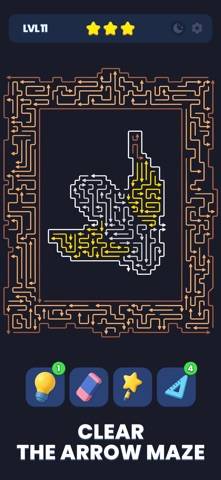
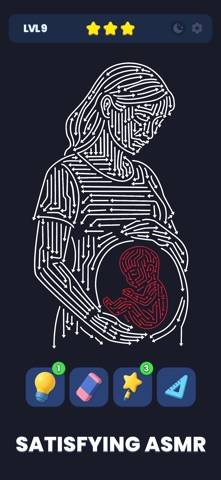
Point Out is not described as merely tapping arrows that already have a clear exit. Its listing includes rotating arrows and shifting tiles, suggesting a maze you actively reorganize rather than only peel apart. This source-based analysis uses the US App Store listing, not hands-on play.
The developer describes guiding the right arrow out of a maze through directional logic and spatial planning. Rotation and tile shifting are the stated interactions. The goal is escape, but the path may need to be changed before it becomes useful.
That distinction matters when comparing it with directional block-removal puzzles. In a fixed-arrow system, you look for the correct removal order. Here, the described ability to alter orientations means creating the route can be part of the solution.
The supplied text does not establish every move restriction or how many arrows must escape. It also does not explain whether all rotations are freely reversible. Those rules should not be invented from the title or from similar-looking games.
The listing names Zoom, Hint, Magic Wand, Rubber, and Grid Scale. Zoom and Grid Scale address inspection and visibility; Hint suggests a move; the other tools are described as helping through difficult situations or erasing mistakes.
That range is potentially useful because a maze can be hard for different reasons. Not seeing a path clearly is not the same problem as understanding the next step. A larger view may help with one without solving the other.
A dark mode is also advertised. Its actual contrast, text size, and effectiveness have not been inspected. The evidence supports saying the setting exists in the feature list, not certifying comfortable use for a particular person.
The developer promotes thousands of handcrafted levels, offline-friendly play, and IQ improvement. No review bodies are available to assess level variety or player satisfaction. No outcome evidence supports treating the app as a validated intelligence-training tool.
The US metadata lists a free download. The supplied description does not establish ad frequency, tool prices, or removal terms. Offline-friendly is likewise not a complete guarantee that every feature works without a connection.
Point Out is a plausible fit for players who enjoy reconfiguring a route instead of just recognizing an open one. It is less clearly suited to someone seeking a fully specified, pure arrow-removal puzzle. Rotation, shifting, and visibility tools are its best documented distinctions; the economy and actual puzzle quality remain untested.
View the official US App Store listing · How evidence differs from playtesting
No gameplay, ad, purchase, offline, or stability testing performed.
Gameplay was not playtested. Default score 7.0. This dimension was not playtested, and the default is what the ranking uses.
Ads were not playtested, and this game has no separate store-ad sample. The no-forced-ads tag stays unknown. Default score 7.0. This dimension was not playtested, and the default is what the ranking uses.
Whether a purchase is required to keep playing was not playtested. Default score 7.0. This dimension was not playtested, and the default is what the ranking uses.
Content depth was not playtested. Default score 7.0. This dimension was not playtested, and the default is what the ranking uses.
Stability was not playtested. Default score 7.0. This dimension was not playtested, and the default is what the ranking uses.

Yes. Rotation and tile shifting are explicitly described.
No. The listing suggests route reconfiguration as well as escape.
Yes, although the setting was not independently inspected.
No. The supplied evidence contains marketing language, not validated training outcomes.