G
7.0
Gameplay 30%
Gameplay was not playtested. Default score 7.0. This dimension was not playtested, and the default is what the ranking uses.


Home / Reviews / hex-number-merge / Merge Hexa™ Number Puzzle Game
Merge Hexa has supporters of its strategic number growth, but reported endgame repetition and placement mishaps are meaningful qualifications. Contrasting ad accounts prevent a simple free-versus-paid experience guarantee.
Opens the official store and leaves this site. Kids: ask a grown-up before buying anything.
Player-review analysis, not a playtest. Sources: the US App Store listing and 50 US reviews dated 2025-11-28–2026-11-07 (Asia/Shanghai), covering versions 2.8.7–3.0.1. This limited, self-selected sample is not representative; player reports are not independently verified.
Merge Hexa™ Number Puzzle Game builds a score by placing numbered hexagons and combining matching values. Preserving useful board space matters alongside reaching a larger number.
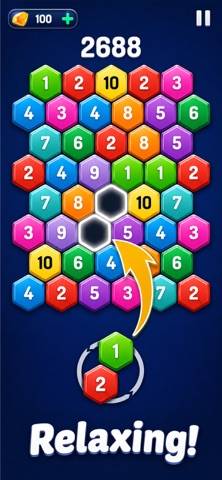
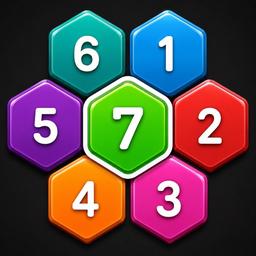
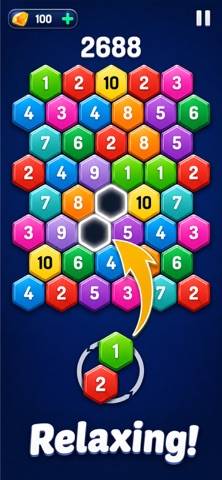
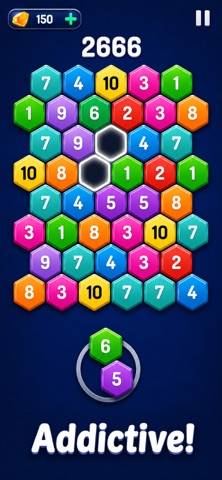
The listing says to drag blocks onto the board, match equal numbers, and keep room available. The official image shows a populated hex grid, a paired incoming piece, and a curved rotation-looking control below.
It does not provide a complete merge threshold or placement guide. The family is number merging, not a verified clone of falling-block Tetris, despite one reviewer expecting that from an advertisement.
Supporters describe repeated daily play and an enjoyable strategic challenge. Another finds the game easy after discovering a reliable method. Difficulty is not a single agreed quality in the sample.
Several invested reviewers say progression reaches 999 or an infinity stage and then becomes repetitive. One otherwise satisfied purchaser wants additional rounds rather than merely more time with the same endgame.
Those are historical reports across versions, not an independently audited current cap. They are still relevant to someone choosing specifically for indefinitely rising numerical targets.
A restart request also deserves precision: one player cannot find a new-game control and explicitly allows that it may exist unnoticed. That uncertainty should not become a definitive missing-feature claim.
Two accounts describe tiles jumping onto the board while the player tries to rotate or taps unintentionally. Another finds Pencil input inaccurate on an iPad. These are reported control concerns, not reproduced device findings.
A separate reviewer describes locked cells needing diamonds later in progression. This is a spending-pressure account, not proof that every possible path requires cash.
One supporter says ads do not follow every round, while another reports interruptions after a few moves. Purchasers also disagree: one has no regrets about removal, and another says ads continued after payment.
The US download is free. Present prices, removal coverage, and stability are unresolved. Offline play is advertised and supported by a reviewer’s account, without full feature testing.
Consider Merge Hexa for spatial number building rather than an assumed infinite campaign. Readers who dislike accidental input or care about a permanent removal offer should inspect those independently.
Merge Hexa has supporters of its strategic number growth, but reported endgame repetition and placement mishaps are meaningful qualifications. Contrasting ad accounts prevent a simple free-versus-paid experience guarantee.
The supplied rules describe dragging hexagons into a merging board, not a documented Tetris ruleset.
Several reviewers describe a cap or repetitive infinity stage. Current progression was not independently audited.
The developer advertises it and one reviewer reports it working; complete feature coverage remains untested.
No hands-on gameplay, advertising, purchase, offline, or stability testing.
Gameplay was not playtested. Default score 7.0. This dimension was not playtested, and the default is what the ranking uses.
Ads were not playtested, and this game has no separate store-ad sample. The no-forced-ads tag stays unknown. Default score 7.0. This dimension was not playtested, and the default is what the ranking uses.
Whether a purchase is required to keep playing was not playtested. Default score 7.0. This dimension was not playtested, and the default is what the ranking uses.
Content depth was not playtested. Default score 7.0. This dimension was not playtested, and the default is what the ranking uses.
Stability was not playtested. Default score 7.0. This dimension was not playtested, and the default is what the ranking uses.
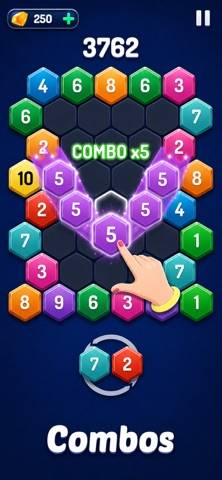
The supplied rules describe dragging hexagons into a merging board, not a documented Tetris ruleset.
Several reviewers describe a cap or repetitive infinity stage. Current progression was not independently audited.
The developer advertises it and one reviewer reports it working; complete feature coverage remains untested.