G
7.0
Gameplay 30%
Gameplay was not playtested. Default score 7.0. This dimension was not playtested, and the default is what the ranking uses.


Home / Reviews / directional-line-removal-art / Maze Madness - Brain Puzzle

Maze Madness looks relevant to readers who enjoy patiently releasing interdependent pieces and watching an image emerge. It is less conclusive for someone expecting traditional maze navigation or verified penalty-free tapping. Zoom and grid tools are concrete advertised aids, while their practical usability remains untested.
Opens the official store and leaves this site. Kids: ask a grown-up before buying anything.
Maze Madness calls its boards mazes, but the published instructions focus on removing pieces along fixed directions. That makes escape order more important than steering a character through corridors. This source-based analysis uses the US App Store listing, not hands-on play.
The developer says tapping releases a piece along its path, with each piece moving in only one direction. Removing an outer layer opens the way for pieces deeper in the arrangement.
This describes an unblock-style dependency problem. A sensible reading is to inspect routes before committing, rather than assuming the title means tracing one continuous line from entrance to exit.
The description does not give exact collision consequences, mistake allowances, or whether a blocked attempt consumes a resource. Those rules remain open rather than being borrowed from other arrow games.
Zoom is advertised for tight spots, and grid lines can be toggled to align the view. They serve different purposes: magnification makes a detail larger, while alignment helps compare positions along a route.
That pairing may interest readers who enjoy inspecting a dense arrangement deliberately. It does not independently establish ideal tap targets, comfortable contrast, or complete accessibility for any particular visual need.
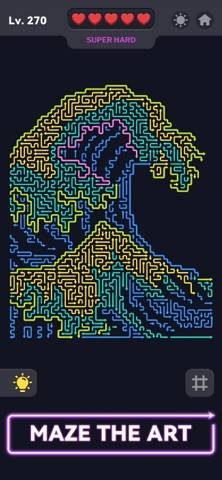
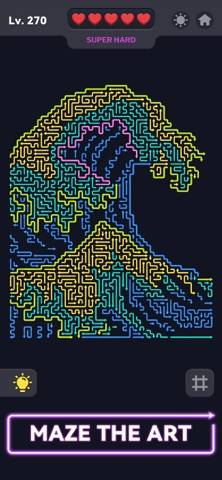
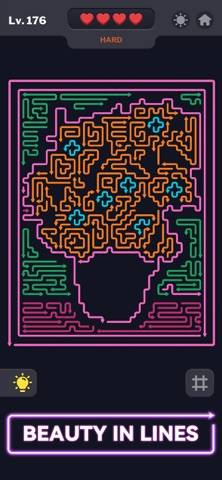
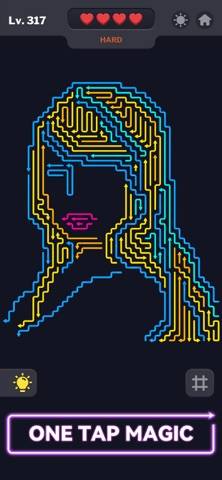
The source describes glowing lines against a dark background, but no screenshot was inspected. The appearance is therefore attributed to the listing, not described as a firsthand observation.
The developer advertises more than 3,000 levels involving familiar artwork, sculptures, animals, and abstract shapes. Revealing an image supplies a reward beyond an empty board.
These references do not prove museum-grade reproductions, art-history lessons, or verified licensing. The advertised catalog was not independently counted. Nor are claims about sharpening IQ established by the supplied evidence.
The listing clearly promotes no timer. It does not provide enough detail to certify unlimited assistance, offline operation, or a particular advertising model.
No customer-review bodies are available in the supplied evidence. There is no supported player consensus about challenge, repetition, comfort, or reliability. The metadata records a free download, not proof that every surrounding feature is unrestricted.
Maze Madness looks relevant to readers who enjoy patiently releasing interdependent pieces and watching an image emerge. It is less conclusive for someone expecting traditional maze navigation or verified penalty-free tapping. Zoom and grid tools are concrete advertised aids, while their practical usability remains untested.
View the official US App Store listing · How evidence differs from playtesting
No gameplay, ad, purchase, offline, or stability testing performed.
Gameplay was not playtested. Default score 7.0. This dimension was not playtested, and the default is what the ranking uses.
Ads were not playtested, and this game has no separate store-ad sample. The no-forced-ads tag stays unknown. Default score 7.0. This dimension was not playtested, and the default is what the ranking uses.
Whether a purchase is required to keep playing was not playtested. Default score 7.0. This dimension was not playtested, and the default is what the ranking uses.
Content depth was not playtested. Default score 7.0. This dimension was not playtested, and the default is what the ranking uses.
Stability was not playtested. Default score 7.0. This dimension was not playtested, and the default is what the ranking uses.
No. The instructions concern tapping pieces out.
The listing says each moves in one direction.
Yes, as an alignment aid.
No. Offline operation is not established here.