G
7.0
Gameplay 30%
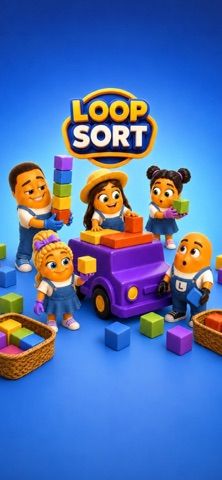
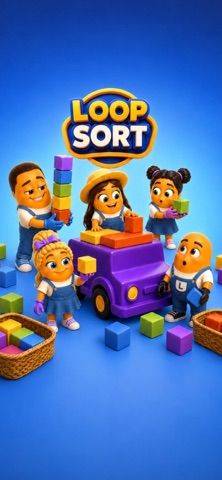
Screenshot impression 6.5/10: The cartoon characters and color blocks look lively, but the loop-sort rule is not obvious in a still. Default score 7.0. This dimension was not playtested, and the default is what the ranking uses.


Home / Reviews / conveyor-color-sort / Loop Sort
Loop Sort is an interesting prospect for players who enjoy directing a process rather than moving every object themselves. It is less clearly suited to someone who wants fully specified rules before starting. The obstacle list supplies genuine mechanical identity, but the actual pacing and free-play economy remain unassessed.
Opens the official store and leaves this site. Kids: ask a grown-up before buying anything.
Loop Sort's listing puts a small but important decision before an automatic process: choose which truck releases its cubes. The conveyor does the visible moving, but the player is responsible for creating a useful order. This source-based analysis uses the US App Store listing, not hands-on play.
The developer describes tapping a truck to send cubes onto a conveyor, where they sort automatically. Matching and clearing cubes advances the level. That makes the game sound more like managing input to a system than manually placing every block into a destination.
The difference matters. A tap can change what arrives on the line next, so the relevant question is not simply whether a truck is available. It is whether its contents help with the current obstacle or make the next stage easier to resolve.
The saved description does not specify the conveyor's capacity, exact match threshold, or complete failure condition. It also does not establish that every truck's contents are visible. Any detailed claim about those rules would go beyond the evidence.
Four obstacles are explicitly named. Hidden blocks require revealing what lies behind them. Curtains lift after sorting a required color. Ice blocks must be broken to free cubes. Barriers prevent cubes inside from leaving while permitting new cubes to enter.
The barriers provide a particularly interesting asymmetry: entry and exit are not equivalent. A space can accept something without being able to release what it already holds. That could require planning around dependencies rather than assuming the entire line remains freely available.
These are developer-described behaviors, not tested explanations of individual levels. The supplied text does not say exactly how ice breaks or how hidden contents are previewed. It is enough to identify a more specific puzzle premise than the broad title alone provides.
No customer-review bodies were available. There is no basis here for claims about players finding the automatic sorting satisfying, the obstacles repetitive, or the later levels unfair.
The download price is recorded as free, but the supplied description does not establish ads, paid assistance, offline support, or an ad-removal offer. Automatic animation also does not prove that the game is a passive idle experience: choosing the release order is still the documented interaction.
Loop Sort is an interesting prospect for players who enjoy directing a process rather than moving every object themselves. It is less clearly suited to someone who wants fully specified rules before starting. The obstacle list supplies genuine mechanical identity, but the actual pacing and free-play economy remain unassessed.
View the official US App Store listing · How evidence differs from playtesting
No gameplay, ad, purchase, offline, or stability testing performed.
Screenshot impression 6.5/10: The cartoon characters and color blocks look lively, but the loop-sort rule is not obvious in a still. Default score 7.0. This dimension was not playtested, and the default is what the ranking uses.
No remove-ads purchase or ad button was found on the store page or the three screenshots. Forced ads were not playtested, so the no-forced-ads tag stays unknown. No ad control or no-ads claim was found, so Ads is drawn from 6.0–8.0. Sampled Ads score 7.0. Not a playtest.
The US App Store lists in-app purchases: Tiny Coin Pack ($1.99); Small Bundle ($5.99); Medium Bundle ($12.99); Small Coin Pack ($7.99); plus 6 more. Whether any purchase is required to keep playing was not playtested. Default score 7.0. This dimension was not playtested, and the default is what the ranking uses.
Store content note: The store describes it as “level progression.” The store page does not clearly state a fail state. Default score 7.0. This dimension was not playtested, and the default is what the ranking uses.
Stability was not played. Age rating shown on the store is 4+. App version on the listing is 4.9.0. Default score 7.0. This dimension was not playtested, and the default is what the ranking uses.
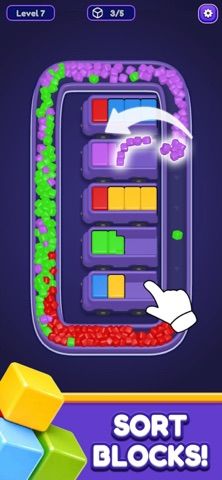
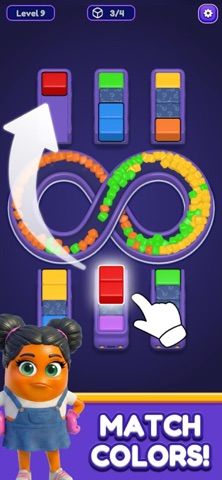
It releases cubes onto the conveyor, according to the listing.
The description says the cubes sort automatically after release; the player still chooses when to send them.
They are described as allowing new cubes in while preventing the cubes inside from leaving.
No. Neither is established by the saved evidence.