G
7.0
Gameplay 30%
Gameplay was not playtested. Default score 7.0. This dimension was not playtested, and the default is what the ranking uses.


Home / Reviews / logic-grid-deduction / Logic Puzzles - Clue Game
Logic Puzzles gives a comparatively clear account of how category deduction works. Story variety and no-time-limit language are useful stated features, while checking rules and hint quality remain open.
Opens the official store and leaves this site. Kids: ask a grown-up before buying anything.
Store-listing analysis, not a playtest. This article examines the US App Store description and attributed product claims. Customer review sample: N=0; no review date or version window is available.
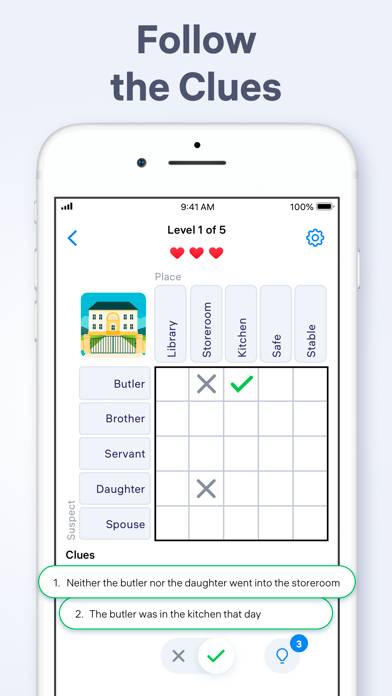
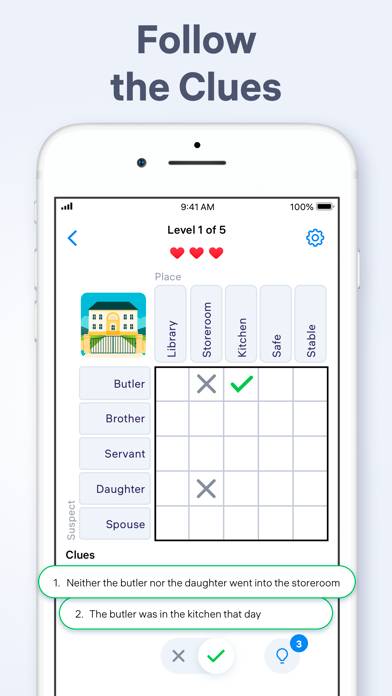
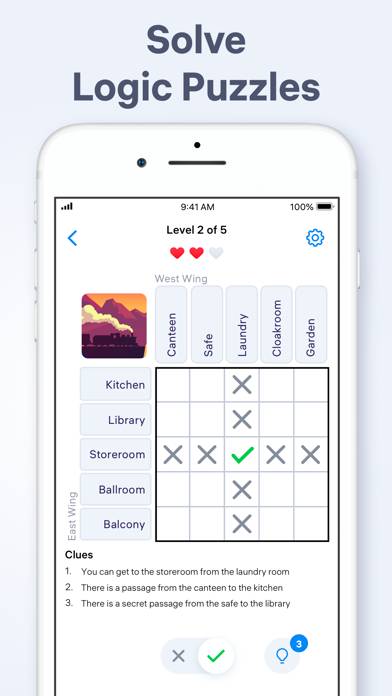
Logic Puzzles - Clue Game turns written facts into a grid of possible relationships. Tick what must be true, cross out what cannot be true, and use those decisions to complete the remaining matches.
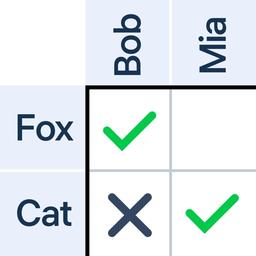
The developer specifies equal numbers of parameters in each category and a one-to-one match across categories. A confirmed association therefore rules out competing associations in that category.
That is the mechanical reason to keep recording exclusions, not simply wait for a clue to name every answer. A negative fact can become useful after other cells have been eliminated.
The official image shows categories for people and places, ticks and crosses, a written clue list, and hearts above. It supports a relationship grid rather than a number-filling Sudoku board.
The listing groups puzzles into theft investigations, vacation planning, a space expedition, and other themed stories. These contexts can make abstract associations easier to remember.
They do not establish branching dialogue, free exploration, or a complete detective simulation. The documented work remains reading limited clues and assigning category relationships.
The supplied material does not define every clue form or whether every puzzle can be solved without trial assumptions. Quality assurances from a familiar developer are promotional claims, not an independent uniqueness audit.
No time limit is explicitly advertised, making deliberate reading a stronger documented fit than reflex play. That remains an attributed product claim rather than a completed mode test.
The hearts in the inspected image leave a separate question: how mistakes affect a puzzle. The description does not establish the allowance, penalties, or whether checking can be disabled.
Hints are offered to reach the solution faster, but their costs, refill conditions, and explanatory depth are unspecified. A hint button should not be called a full deduction tutor without evidence that it explains the logical step.
This format is a reasonable match for readers who like converting sentences into formal exclusions. It is less relevant to someone seeking purely visual shape placement or automatic matching.
The US download is free. Ads, purchases, paid removal, offline support, and save reliability remain unresolved. There are no customer review bodies in this sample to assess clue wording, localization, or late-story access.
Consider Logic Puzzles for its clearly described one-to-one deduction system. Keep the no-clock promise separate from unspecified mistakes and commercial boundaries, rather than assuming every constraint disappears when a game advertises calm play.
Logic Puzzles gives a comparatively clear account of how category deduction works. Story variety and no-time-limit language are useful stated features, while checking rules and hint quality remain open.
The supplied rule says each parameter has only one match in each other category.
No. The listing explicitly says there is no time limit.
That is not established. Hints are advertised without a complete description of their teaching depth.
No hands-on gameplay, advertising, purchase, offline, or stability testing.
Gameplay was not playtested. Default score 7.0. This dimension was not playtested, and the default is what the ranking uses.
Ads were not playtested, and this game has no separate store-ad sample. The no-forced-ads tag stays unknown. Default score 7.0. This dimension was not playtested, and the default is what the ranking uses.
Whether a purchase is required to keep playing was not playtested. Default score 7.0. This dimension was not playtested, and the default is what the ranking uses.
Content depth was not playtested. Default score 7.0. This dimension was not playtested, and the default is what the ranking uses.
Stability was not playtested. Default score 7.0. This dimension was not playtested, and the default is what the ranking uses.
The supplied rule says each parameter has only one match in each other category.
No. The listing explicitly says there is no time limit.
That is not established. Hints are advertised without a complete description of their teaching depth.