G
7.0
Gameplay 30%
Gameplay was not playtested. Default score 7.0. This dimension was not playtested, and the default is what the ranking uses.


Home / Reviews / killer-sudoku / Killer Sudoku by Sudoku.com
This Killer Sudoku has a clearly explained rules foundation and practical candidate-note support. Its fit depends on enjoying arithmetic deduction; access terms and the depth of its teaching remain open questions.
Opens the official store and leaves this site. Kids: ask a grown-up before buying anything.
Store-listing analysis, not a playtest. This article examines the US App Store description and attributed product claims. Customer review sample: N=0; no review date or version window is available.
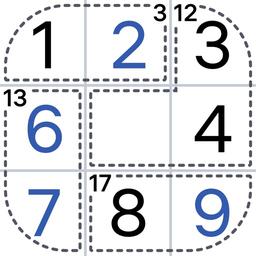
Killer Sudoku by Sudoku.com adds arithmetic boundaries to the familiar number grid. Each dotted cage has a target sum, while ordinary row, column, and 3×3-region restrictions still apply.
A digit must fit its row, column, and region without repeating. It must also contribute to the sum printed in its cage, where digits cannot repeat either. A placement that satisfies one condition can still violate another.
That makes the central activity different from merely calculating a total. You compare possible combinations with the surrounding Sudoku restrictions. A sum can narrow the digits a group contains, while a row or box can narrow where each digit belongs.
The description explicitly points out that a complete row, column, or 3×3 region totals 45. This gives a second arithmetic reference alongside the printed cage totals. It does not establish that a particular advanced technique is taught or that every board has a unique solution.
Notes and hints are listed for difficult positions. Notes are particularly relevant when several combinations remain possible and you want to retain candidates instead of guessing. The description does not explain automatic candidate updates or exactly how a hint reasons through a step.
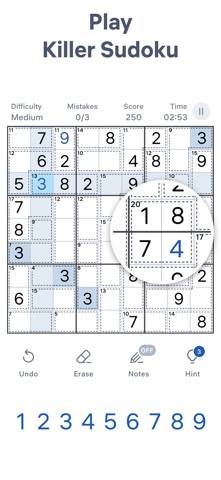
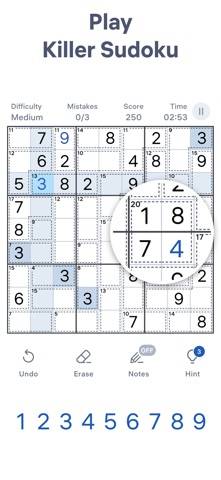
The official image shows a number keypad, dotted cages, Notes and Hint controls, and a mistake counter. It visually supports the hybrid arithmetic-and-Sudoku premise, but does not settle mistake limits or the effect of reaching one.
Thousands of levels, daily trophies, and seasonal medals provide progression options. Their existence is not evidence that every difficulty suits beginners, despite the developer’s broad accessibility pitch.
Consider this app if you enjoy Sudoku’s overlapping constraints and want cage arithmetic to contribute additional information. It is less suitable if arithmetic is precisely what you want to avoid or if you are seeking a freeform number-merging game.
The US download is free. Advertising frequency, purchases, offline availability, and hint replenishment are not established by the supplied description. There are no customer review bodies in this sample, so no player consensus about fairness or instruction quality is available.
The strongest reason to investigate is the documented interaction between sums and nonrepetition, not the promise of becoming a master quickly or a measured improvement in general intelligence.
This Killer Sudoku has a clearly explained rules foundation and practical candidate-note support. Its fit depends on enjoying arithmetic deduction; access terms and the depth of its teaching remain open questions.
No. The listed rules prohibit repetition within a cage as well as rows, columns, and 3×3 regions.
The digits inside the dotted cage must add to the printed target sum.
A completed row, column, or 3×3 region contains the digits 1–9, which total 45.
No hands-on gameplay, advertising, purchase, offline, or stability testing.
Gameplay was not playtested. Default score 7.0. This dimension was not playtested, and the default is what the ranking uses.
Ads were not playtested, and this game has no separate store-ad sample. The no-forced-ads tag stays unknown. Default score 7.0. This dimension was not playtested, and the default is what the ranking uses.
Whether a purchase is required to keep playing was not playtested. Default score 7.0. This dimension was not playtested, and the default is what the ranking uses.
Content depth was not playtested. Default score 7.0. This dimension was not playtested, and the default is what the ranking uses.
Stability was not playtested. Default score 7.0. This dimension was not playtested, and the default is what the ranking uses.


No. The listed rules prohibit repetition within a cage as well as rows, columns, and 3×3 regions.
The digits inside the dotted cage must add to the printed target sum.
A completed row, column, or 3×3 region contains the digits 1–9, which total 45.