G
7.0
Gameplay 30%
Screenshot impression 6.5/10: A pixel duck and a ring of colored cars suggest a jam or sort, and the rule takes a moment to read. Default score 7.0. This dimension was not playtested, and the default is what the ranking uses.



Home / Reviews / traffic-sand-sequencing / Jam Bus:Sandfall

Jam Bus: Sandfall is an interesting listing for traffic-puzzle fans who want another layer of dependency beyond moving vehicles out of a jam. It is not yet an evidence-backed recommendation for flawless pacing or relaxed sessions. Choose it for the route-and-layer concept, with realistic expectations about how much the saved material proves.
Opens the official store and leaves this site. Kids: ask a grown-up before buying anything.
Jam Bus: Sandfall replaces the usual passenger queue with layered colored sand. That change gives its traffic puzzle two linked dependencies: a bus needs a usable route, and the sand it wants needs to be accessible. This source-based analysis uses the US App Store listing, not hands-on play.
The developer describes tapping a bus to send it along a route and collect matching-color sand. Buses have their own colors and directions. Routes can cross, vehicles can block one another, and the stated goal includes avoiding crashes while clearing the board.
Sand layers complicate the order. The description specifically says lower layers must be cleared to unlock those above. A visible color is therefore not necessarily a useful immediate target. The right choice depends on what that collection frees for the next bus, not just whether the colors match.
This is a sequencing puzzle rather than a driving simulation. The supplied rules emphasize observation and deciding when to tap. They do not establish free steering, realistic traffic behavior, or a complete route-editing system.
The sand theme creates a potentially useful distinction from ordinary bus-loading puzzles. In a passenger game, the queue and seat count often determine whether a departure helps. Here, the documented dependency is between vehicle routes and layers of material.
That could appeal to players who enjoy a board gradually unlocking itself. It may be less suitable for someone who wants a single, isolated matching decision each turn. A bus that appears ready to move can still be a poor choice if its path conflicts with another route.
The evidence is limited to a short listing, with no saved customer-review bodies. There is no basis for saying players praise the sand effects or complain about crash penalties. The description also does not explain whether a failed sequence can be undone, how collisions are detected, or whether every layout permits several solutions.
The US metadata records a free download. Nothing in the supplied description provides reliable ad frequency, booster costs, or an ad-removal promise. Offline access and stability are also unverified. The attractive idea of watching sand clear cannot resolve those practical questions.
Jam Bus: Sandfall is an interesting listing for traffic-puzzle fans who want another layer of dependency beyond moving vehicles out of a jam. It is not yet an evidence-backed recommendation for flawless pacing or relaxed sessions. Choose it for the route-and-layer concept, with realistic expectations about how much the saved material proves.
View the official US App Store listing · How evidence differs from playtesting
No gameplay, ad, purchase, offline, or stability testing performed.
Screenshot impression 6.5/10: A pixel duck and a ring of colored cars suggest a jam or sort, and the rule takes a moment to read. Default score 7.0. This dimension was not playtested, and the default is what the ranking uses.
The US App Store lists a remove-ads purchase: Remove ADS ($9.99). Forced ads were not playtested, so the no-forced-ads tag stays unknown. The store lists a remove-ads purchase, so Ads is drawn from 4.5–6.5. Sampled Ads score 5.0. Not a playtest.
The US App Store lists in-app purchases: coinpackage ($1.99); Speed Pack ($7.99); Booster Pack ($19.99); Starter Pack ($1.99); plus 6 more. Whether any purchase is required to keep playing was not playtested. Default score 7.0. This dimension was not playtested, and the default is what the ranking uses.
Store content note: The store describes it as “level progression.” The store page does not clearly state a fail state. Default score 7.0. This dimension was not playtested, and the default is what the ranking uses.
Stability was not played. Age rating shown on the store is 4+. App version on the listing is 1.0.1. Default score 7.0. This dimension was not playtested, and the default is what the ranking uses.

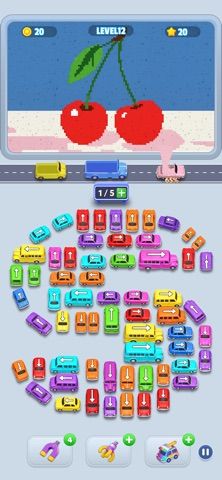
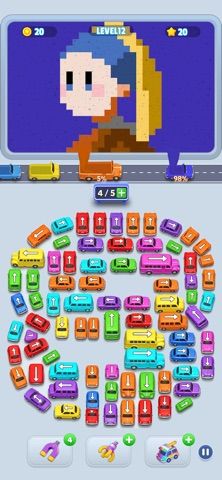
They collect sand matching their own color, according to the listing.
The description says lower sand layers must clear before the layers above become accessible.
Avoiding crashes on crossing routes is an explicit part of the advertised rules.
No usable review bodies were available for this app in the saved evidence.