G
7.0
Gameplay 30%
Gameplay was not playtested. Default score 7.0. This dimension was not playtested, and the default is what the ranking uses.


Home / Reviews / definition-cryptogram / Figgerits - Word Puzzle Games
Figgerits has a clear decoding appeal, but missing autofill dominates the detailed interface accounts. It is worth distinguishing thought-provoking clues from repeated transcription and interruption rather than conflating them into one difficulty score.
Opens the official store and leaves this site. Kids: ask a grown-up before buying anything.
Player-review analysis, not a playtest. Sources: the US App Store listing and 50 US reviews dated 2026-03-11–2026-11-08 (Asia/Shanghai), covering version 2.4.2. This limited, self-selected sample is not representative; player reports are not independently verified.
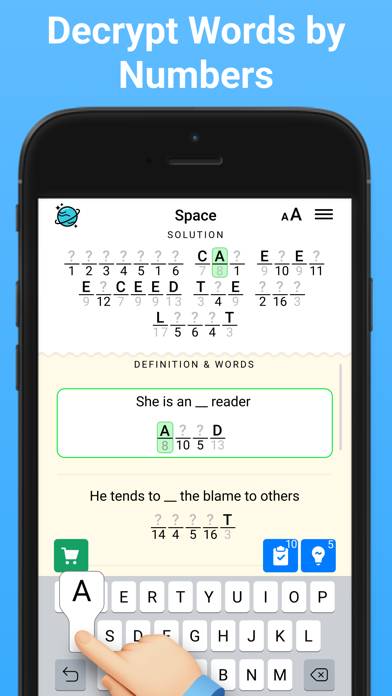
Figgerits - Word Puzzle Games connects definition clues to a coded message. Solve a word, identify how its letters correspond to numbers, and use those relationships to complete the larger phrase.
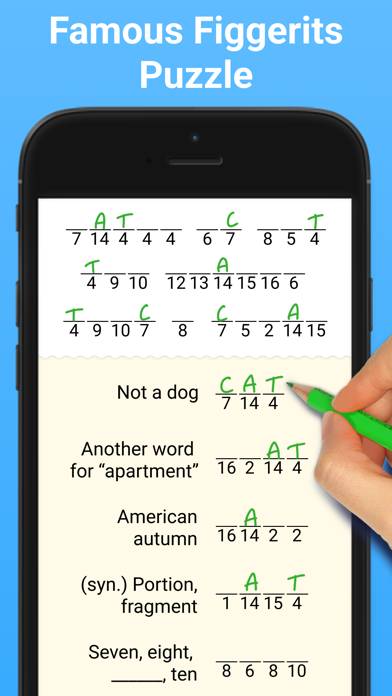
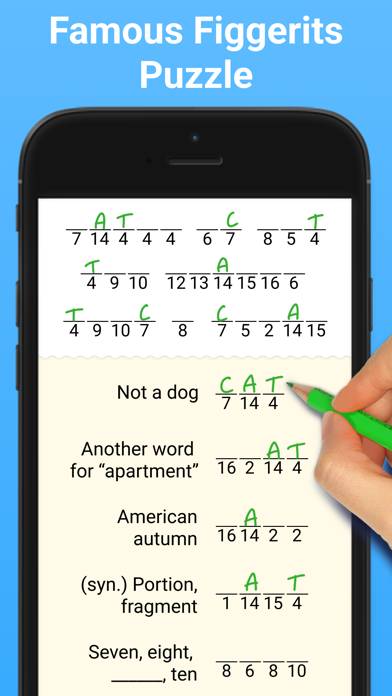
The listing instructs you to guess words, transfer letters to numbered dashes, and return to incomplete answers. The official image shows definitions such as not-a-dog beside CAT and numbered answer positions.
The task is closer to a clue-driven cryptogram than an IQ test, despite the developer’s brainpower language. No standardized intelligence assessment or measured cognitive improvement is established.
One player likes learning unfamiliar large words, while another calls the puzzle intriguing. The appeal can survive criticism of the interface or commercial layer.
Multiple detailed reviewers say letters formerly filled corresponding number positions automatically but now require repeated manual entry. They describe scrolling between clues and the message even after identifying the solution.
This distinction matters because deduction and transcription are different work. Solving the letter mapping can be satisfying while copying it into every location feels tedious.
The supplied description does not explicitly guarantee automatic filling in every present mode. Reports of its loss remain attributed rather than an independently reproduced update history.
A reviewer says repeated clicking causes accidental wrong entries and restarts. Another reports a three-mistake loss condition after a change.
These are bounded accounts, not a confirmed universal error budget. They explain why a request for autofill is not just a desire for easier clues.
An older-device comparison within one review does not independently prove every phone has a different rule. Nor does a same-version sample establish uniform account settings.
Several reviewers report ad breaks in the middle of solving, separate from beginning and end commercials. Others say ads can remain stuck, forcing a restart.
One October supporter pays for removal because they like the puzzle. Another requests a paid edition, and a purchaser separately complains about losing autofill despite payment. Current offer coverage and hint entitlements remain unresolved.
The US download is free. Offline behavior, save recovery, and present stability were not tested. A reviewer reports lost progress after reinstallation, which should not be turned into recommended troubleshooting.
Consider Figgerits for clue-and-code reasoning if manual repetition is acceptable. Readers mainly attracted to cascading automatic reveals should treat that behavior as a selection question rather than assume the old experience remains intact.
Figgerits has a clear decoding appeal, but missing autofill dominates the detailed interface accounts. It is worth distinguishing thought-provoking clues from repeated transcription and interruption rather than conflating them into one difficulty score.
No. It is a clue-and-number word puzzle; cognitive claims are not a validated assessment.
No. Multiple reviewers say automatic propagation disappeared, and current behavior was not tested.
Not necessarily. Removal, hints, and automatic letter behavior have separate unresolved boundaries.
No hands-on gameplay, advertising, purchase, offline, or stability testing.
Gameplay was not playtested. Default score 7.0. This dimension was not playtested, and the default is what the ranking uses.
Ads were not playtested, and this game has no separate store-ad sample. The no-forced-ads tag stays unknown. Default score 7.0. This dimension was not playtested, and the default is what the ranking uses.
Whether a purchase is required to keep playing was not playtested. Default score 7.0. This dimension was not playtested, and the default is what the ranking uses.
Content depth was not playtested. Default score 7.0. This dimension was not playtested, and the default is what the ranking uses.
Stability was not playtested. Default score 7.0. This dimension was not playtested, and the default is what the ranking uses.
No. It is a clue-and-number word puzzle; cognitive claims are not a validated assessment.
No. Multiple reviewers say automatic propagation disappeared, and current behavior was not tested.
Not necessarily. Removal, hints, and automatic letter behavior have separate unresolved boundaries.