G
7.0
Gameplay 30%
Gameplay was not playtested. Default score 7.0. This dimension was not playtested, and the default is what the ranking uses.


Home / Reviews / competitive-word-board / Easy Words - Word Puzzle Games
Easy Words supplies unusually concrete board dimensions and scoring foundations. Its dictionary is a useful stated tool, while opponent identity and assistance costs remain important unanswered selection points.
Opens the official store and leaves this site. Kids: ask a grown-up before buying anything.
Store-listing analysis, not a playtest. This article examines the US App Store description and attributed product claims. Customer review sample: N=0; no review date or version window is available.
Easy Words - Word Puzzle Games offers a turn-based letter-board contest. Build connected words for points, using each letter’s value and the board’s bonus cells to improve the result.
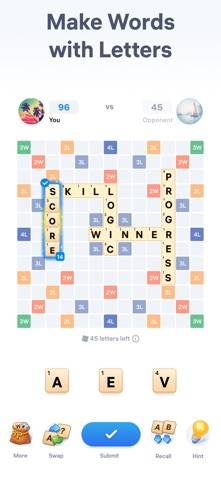
The developer specifies a 13×13 board and seven letter tiles per player. Words run horizontally or vertically. The opening word must contain at least two letters and place a tile on the center square.
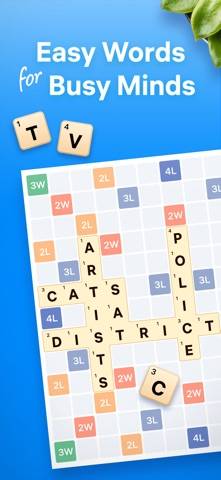
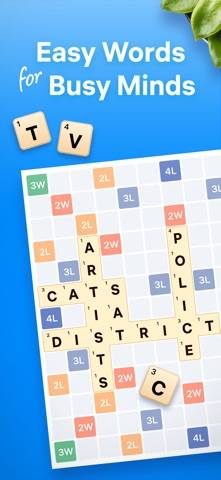
The official image shows intersecting words and cells labeled with letter or word multipliers. It supports strategic placement rather than searching a completed letter matrix.
A word’s usefulness therefore depends on more than its length: where its letters land can change the points earned. The supplied description does not establish every crossing-validation or tile-replacement rule, so this is not a complete competitive rulebook.
Bonus spaces can multiply an individual letter or a whole word. The text does not specify whether a bonus can be reused, how multiple bonuses combine, or whether using all seven tiles produces a separate reward.
Those familiar word-board questions should not be answered from another game’s conventions. The exact dictionary and challenge system also remain undocumented.
The opponent’s identity is not established: the listing describes competition but does not independently prove live human matchmaking or a particular computer difficulty setting.
A built-in dictionary supplies definitions for words added to the board. This is a more concrete learning-related feature than a general claim to train the brain, although definition quality and coverage were not tested.
Hints offer assistance, Swap replaces rack tiles, and Shuffle changes their presentation. The description does not establish their costs, whether they consume a turn, or how frequently they can be used.
The listed game ends when a player uses the last tile, both skip twice consecutively, or a player has no possible moves. The higher score wins. Those conditions are the developer’s stated rules, not a reason to assume an unlimited back-and-forth session.
The US download is free. Advertising, purchases, paid removal, offline access, and timing remain unresolved. No customer review bodies are available in this sample.
Consider Easy Words if rack management and multiplier placement are the task you want. It is less relevant to someone seeking a solitary clue crossword or a confirmed ad-free vocabulary lesson.
Easy Words supplies unusually concrete board dimensions and scoring foundations. Its dictionary is a useful stated tool, while opponent identity and assistance costs remain important unanswered selection points.
The developer specifies seven tiles on a 13×13 board.
The supplied rules describe horizontal and vertical words, not diagonal placement.
Yes. A built-in dictionary is advertised for words added to the board; quality was not independently assessed.
No hands-on gameplay, advertising, purchase, offline, or stability testing.
Gameplay was not playtested. Default score 7.0. This dimension was not playtested, and the default is what the ranking uses.
Ads were not playtested, and this game has no separate store-ad sample. The no-forced-ads tag stays unknown. Default score 7.0. This dimension was not playtested, and the default is what the ranking uses.
Whether a purchase is required to keep playing was not playtested. Default score 7.0. This dimension was not playtested, and the default is what the ranking uses.
Content depth was not playtested. Default score 7.0. This dimension was not playtested, and the default is what the ranking uses.
Stability was not playtested. Default score 7.0. This dimension was not playtested, and the default is what the ranking uses.
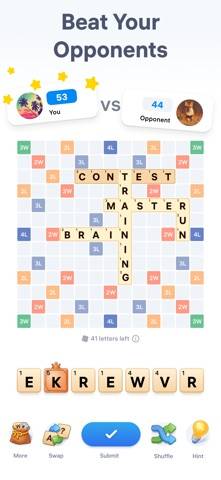
The developer specifies seven tiles on a 13×13 board.
The supplied rules describe horizontal and vertical words, not diagonal placement.
Yes. A built-in dictionary is advertised for words added to the board; quality was not independently assessed.