G
7.0
Gameplay 30%
Gameplay was not playtested. Default score 7.0. This dimension was not playtested, and the default is what the ranking uses.


Home / Reviews / lateral-riddle / Brain Out -Tricky riddle games
Brain Out’s clearest fit is a reader who enjoys comic misdirection and scene-based surprises. Its intelligence-testing language is not evidence of a validated test, and practical access conditions remain unresolved.
Opens the official store and leaves this site. Kids: ask a grown-up before buying anything.
Store-listing analysis, not a playtest. This article examines the US App Store description and attributed product claims. Customer review sample: N=0; no review date or version window is available.
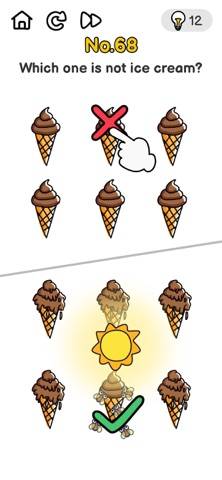
Brain Out -Tricky riddle games asks you to distrust the obvious interpretation. Its advertised attraction is a sequence of visual riddles whose answers may deliberately subvert ordinary expectations.
The description emphasizes absurd solutions, creative thinking, and questions that should not be answered conventionally. That makes Brain Out different from a logic grid whose rules stay fixed while the clues change.
A player may need to reconsider what the scene or wording means rather than apply one learned technique repeatedly. The supplied text does not document the gesture vocabulary, however. It would be misleading to promise specific shaking, dragging, or multi-finger tricks without evidence for them.
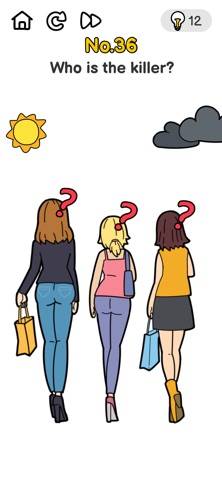
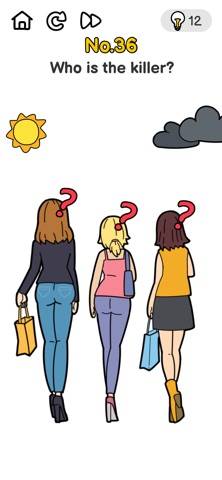
The official image shows a question asking who the killer is, with three illustrated women, weather symbols, and an infinity icon. It establishes a scene-based question format, but does not reveal the answer or explain the icon’s full function.
Funny effects and unexpected answers are central to the pitch. Consider this format if a surprising reveal is enjoyable even when it is less rigorous than mathematical deduction. Someone who wants every solution to follow a consistent, fully stated rule may prefer another genre.
The description uses trivia language too, but does not provide a syllabus or establish that general knowledge alone will solve the puzzles. Its stronger claim is lateral interpretation, not a verified reference quiz.
Likewise, IQ and EQ language should not be mistaken for validated testing. No standardized assessment, comparison group, or scoring method is documented. Passing a riddle does not establish a measured intelligence level, and failing one says little about a reader’s ability outside the app.
The US download is free. Advertising, purchases, hint costs, offline support, mistake penalties, and the number of available riddles are not established by the supplied description. The pictured hint icon does not by itself establish unlimited assistance.
There are no customer review bodies in this sample. Claims about players loving the jokes, finding the answers fair, or encountering no interruptions would exceed the evidence.
Choose Brain Out for its stated willingness to surprise and play tricks with interpretation. Skip it if the requirement is a stable deductive rulebook, an academic trivia source, or a clinically meaningful measure of intelligence.
Brain Out’s clearest fit is a reader who enjoys comic misdirection and scene-based surprises. Its intelligence-testing language is not evidence of a validated test, and practical access conditions remain unresolved.
The listing uses IQ language but does not document a standardized or validated intelligence assessment.
The developer emphasizes unexpected answers and changing interpretations rather than a single stable rule set.
The download is free, but the supplied evidence does not establish ad behavior.
No hands-on gameplay, advertising, purchase, offline, or stability testing.
Gameplay was not playtested. Default score 7.0. This dimension was not playtested, and the default is what the ranking uses.
Ads were not playtested, and this game has no separate store-ad sample. The no-forced-ads tag stays unknown. Default score 7.0. This dimension was not playtested, and the default is what the ranking uses.
Whether a purchase is required to keep playing was not playtested. Default score 7.0. This dimension was not playtested, and the default is what the ranking uses.
Content depth was not playtested. Default score 7.0. This dimension was not playtested, and the default is what the ranking uses.
Stability was not playtested. Default score 7.0. This dimension was not playtested, and the default is what the ranking uses.
The listing uses IQ language but does not document a standardized or validated intelligence assessment.
The developer emphasizes unexpected answers and changing interpretations rather than a single stable rule set.
The download is free, but the supplied evidence does not establish ad behavior.