G
7.0
Gameplay 30%
Gameplay was not playtested. Default score 7.0. This dimension was not playtested, and the default is what the ranking uses.


Home / Reviews / rotating-block-placement-dual-mode / Block Blitz: Puzzle Adventure
Block Blitz is most relevant to readers who want orientation choices and both staged and score-driven play. It is less conclusive for someone seeking a transparent difficulty statistic or guaranteed unrestricted rotation. The two modes are clearly distinguished; the percentage's meaning and access conditions remain open questions.
Opens the official store and leaves this site. Kids: ask a grown-up before buying anything.
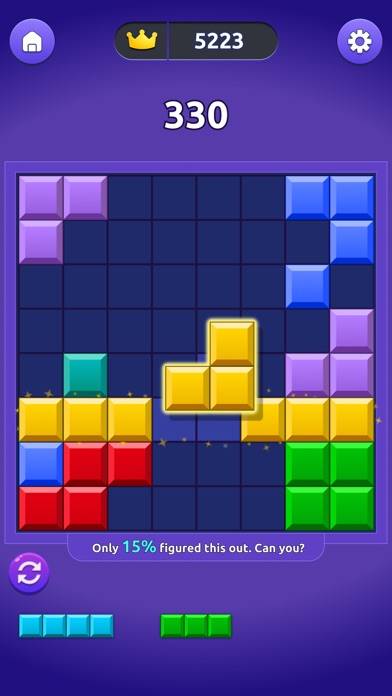
Block Blitz gives block placement two different goals: finish a prepared stage or extend a personal score attempt. Its advertised rotation button is a concrete distinction from games that require every shape to stay as supplied. This source-based analysis uses the US App Store listing, not hands-on play.
The developer describes dragging blocks onto a board, filling lines to clear them, and rotating pieces when space becomes tight. That adds an orientation decision to the usual placement choice.
Rotation may make an awkward shape useful in a different region. It does not establish that every sequence is solvable or that space management no longer matters. The supplied description does not specify the board dimensions, piece-tray size, or the number and cost of rotations.
Those omissions matter to comparison. A rotation button is not automatically a promise of unlimited free turns of every piece.
Journey Mode offers handcrafted stages with particular tasks. High Score Mode emphasizes clearing lines and pushing a personal record, with no timers explicitly advertised for that mode.
The scope of that statement is important: it should not become a no-timer certification for every Journey stage. The listing does not give a complete failure rule for each mode.
A worldwide leaderboard supplies competition, while personal records offer a self-contained goal. Someone who prefers solving a finite arrangement may value Journey more than an open-ended score run.
Each Journey level is advertised with a Chance to Solve percentage. The description does not explain whether that number comes from player completion rates, an algorithm, a test group, or another method.
It therefore should not be presented as a verified probability that a particular person will succeed. Nor does a low percentage prove that a stage is unfair or requires purchases. The statistic is a stated interface feature with an undisclosed calculation.
No independent customer-review bodies are available here. Claims about smooth controls and satisfying flow remain promotional rather than a player consensus. No screenshot was inspected to assess the statistic or rotation control directly.
The metadata records a free download. Ads, removal offers, tool prices, offline operation, and stability remain unverified. Play-anywhere language does not by itself document disconnected access.
Block Blitz is most relevant to readers who want orientation choices and both staged and score-driven play. It is less conclusive for someone seeking a transparent difficulty statistic or guaranteed unrestricted rotation. The two modes are clearly distinguished; the percentage's meaning and access conditions remain open questions.
View the official US App Store listing · How evidence differs from playtesting
No gameplay, ad, purchase, offline, or stability testing performed.
Gameplay was not playtested. Default score 7.0. This dimension was not playtested, and the default is what the ranking uses.
Ads were not playtested, and this game has no separate store-ad sample. The no-forced-ads tag stays unknown. Default score 7.0. This dimension was not playtested, and the default is what the ranking uses.
Whether a purchase is required to keep playing was not playtested. Default score 7.0. This dimension was not playtested, and the default is what the ranking uses.
Content depth was not playtested. Default score 7.0. This dimension was not playtested, and the default is what the ranking uses.
Stability was not playtested. Default score 7.0. This dimension was not playtested, and the default is what the ranking uses.
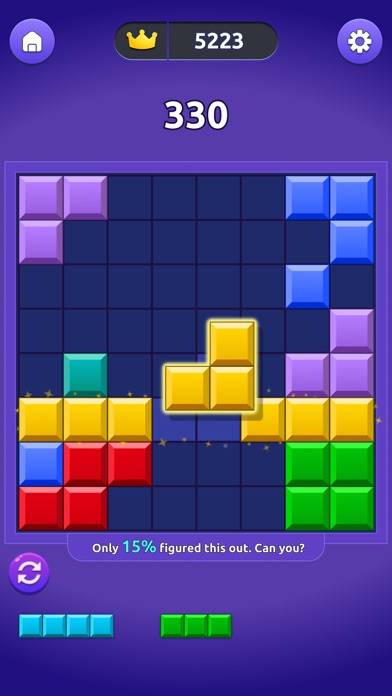
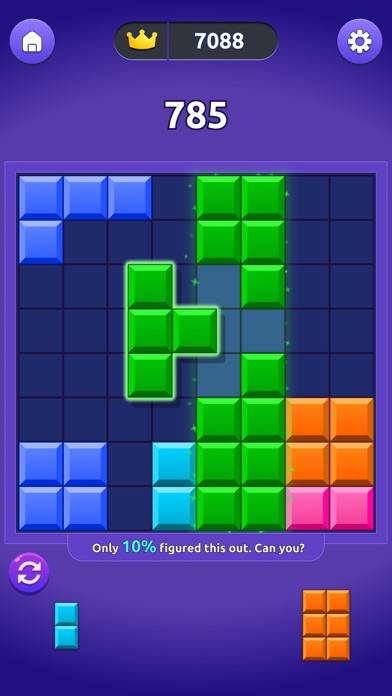
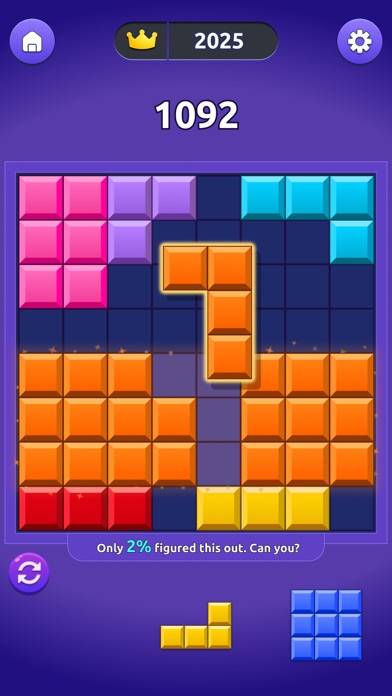
Yes. A rotation button is explicitly named.
High Score Mode.
No. Its calculation is not explained.
Not in the supplied description.