G
7.0
Gameplay 30%
Gameplay was not playtested. Default score 7.0. This dimension was not playtested, and the default is what the ranking uses.


Home / Reviews / 3d-block-escape / Block Away - Tap Out Puzzle
Block Away has supporters of its directional-block challenge, but the source mismatch limits precise instructions. Mid-puzzle coffee breaks and divergent visibility experiences are the most useful cautions for prospective players.
Opens the official store and leaves this site. Kids: ask a grown-up before buying anything.
Player-review analysis, not a playtest. Sources: the US App Store listing and 50 US reviews dated 2026-09-19–2026-11-08 (Asia/Shanghai), covering versions 2.8.6–3.0.0. This limited, self-selected sample is not representative; player reports are not independently verified.
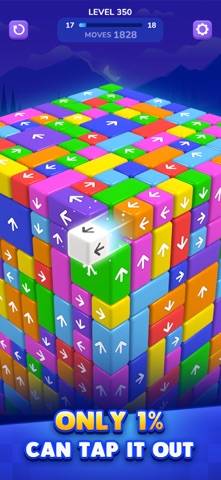
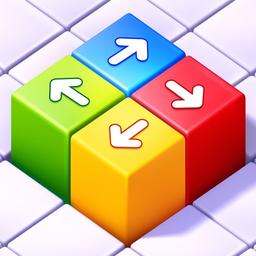
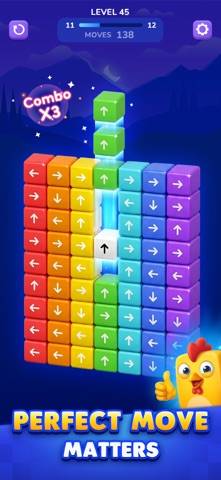
Block Away - Tap Out Puzzle needs a careful introduction because its sources do not tell the same mechanical story. The title, official image, and reviews indicate removing directional blocks from a 3D arrangement.
The written description instead discusses moving and rotating blocks to eliminate rows or columns. That resembles a placement game, but the inspected image shows a large cube of arrow-marked blocks and a tap-it-out caption.
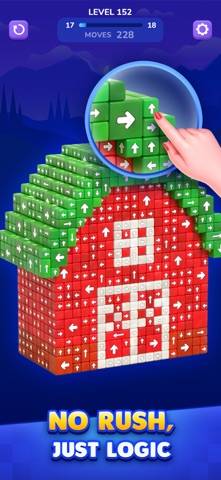
Reviewers likewise describe tapping blocks to remove them, comparing it with arrow puzzles, and managing remaining moves. Those sources support a directional-release family more strongly than a conventional line-fitting recommendation.
The discrepancy remains unresolved. Exact rotation gestures and escape restrictions have not been tested, and the article should not manufacture a hybrid rule set that combines every statement.
One reviewer finds the blocks easier to tap than arrow puzzles. Another struggles when zoom is unavailable and pieces become too small to select accurately. These are different experiences of visibility and input precision, not an established accessibility verdict.
A separate player dislikes blocks moving toward the viewer, and another objects to newer squishy shapes. The motion and rendering are therefore meaningful preferences for readers seeking a visually quiet puzzle.
Detailed reviews repeatedly describe forced mid-level ads labeled coffee breaks. One says these breaks disrupt momentum and strategy, while others simply dislike waiting. The reported counts vary and are not independently measured.
Some players still find the challenge enjoyable or relaxing. That support should not be lost, but it does not make the interruptions harmless to someone maintaining an exit sequence.
The listing describes a monthly Premium subscription removing interstitials and banners while leaving optional rewarded videos. Purchasers report continuing ads, without enough detail to reconcile every entitlement. A no-ads offer is not automatically a promise to remove voluntary videos.
The US download is free. Current pricing, offline support, and the reported freezes have not been verified. Consider Block Away for its visually supported tap-out concept, while checking zoom and motion settings before treating it as a low-stimulation choice.
Block Away has supporters of its directional-block challenge, but the source mismatch limits precise instructions. Mid-puzzle coffee breaks and divergent visibility experiences are the most useful cautions for prospective players.
The description uses that language, but the title, image, and reviews indicate directional tap-out play. The discrepancy is unresolved.
Reviewers use that label for ad interruptions during a level.
The listing says interstitial and banner ads are removed for a monthly subscription period; optional rewarded ads remain available.
No hands-on gameplay, advertising, purchase, offline, or stability testing.
Gameplay was not playtested. Default score 7.0. This dimension was not playtested, and the default is what the ranking uses.
Ads were not playtested, and this game has no separate store-ad sample. The no-forced-ads tag stays unknown. Default score 7.0. This dimension was not playtested, and the default is what the ranking uses.
Whether a purchase is required to keep playing was not playtested. Default score 7.0. This dimension was not playtested, and the default is what the ranking uses.
Content depth was not playtested. Default score 7.0. This dimension was not playtested, and the default is what the ranking uses.
Stability was not playtested. Default score 7.0. This dimension was not playtested, and the default is what the ranking uses.
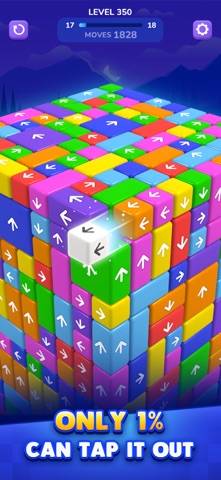
The description uses that language, but the title, image, and reviews indicate directional tap-out play. The discrepancy is unresolved.
Reviewers use that label for ad interruptions during a level.
The listing says interstitial and banner ads are removed for a monthly subscription period; optional rewarded ads remain available.